


Direct answer
When may a hotel be liable for a slip or fall?
A useful first assessment asks four questions:
- 1. Was there a hazard?Water, an unusually slippery surface, uneven flooring, a defective step, poor lighting or an obstruction.
- 2. Should the hotel have acted?Prevention, maintenance, drainage, cleaning, supervision, repair or an effective warning may have been required.
- 3. Did that hazard cause the fall?The mechanics of the accident and competing explanations must be tested against the evidence.
- 4. What loss followed?Injury, treatment, disability, expenses, income loss and personal impact need separate proof.
Portuguese case law treats guest safety as an ancillary duty of the accommodation contract. Once the contract, defective performance, causation and loss are established, Article 799 of the Civil Code requires the debtor to prove that the defective performance was not its fault. A parallel tort claim has its own legal requirements.
What to do after a slip and fall in a Portuguese hotel
The scene can change within minutes. If the injured guest cannot collect evidence, a companion or witness can help without delaying medical care.
- 1. Obtain medical care.Explain where, when and how the fall occurred. Keep triage records, imaging, discharge papers, prescriptions and invoices.
- 2. Photograph the exact location and its context.Record water, tiles, uneven surfaces, drainage, lighting, access routes and every sign. Take wide and close views and keep the original files.
- 3. Identify witnesses separately.Obtain names, contact details and what each person saw: the fall, water, missing warnings, cleaning or later changes.
- 4. Report the accident to the hotel in writing.Ask for the incident report and correct inaccuracies by email. Do not sign an account you do not understand.
- 5. Request preservation of CCTV and records.Identify the time, camera and place. Footage, cleaning schedules and internal reports may be overwritten quickly.
- 6. Keep the booking and all communications.Retain confirmation, invoice, terms, package-organiser details, travel insurance and messages with the hotel or insurer.
- 7. Track expenses and recovery.Separate amounts billed, paid, reimbursed, outstanding or potentially recoverable by a third party.
Wet floors, pool areas and warning signs: what matters?
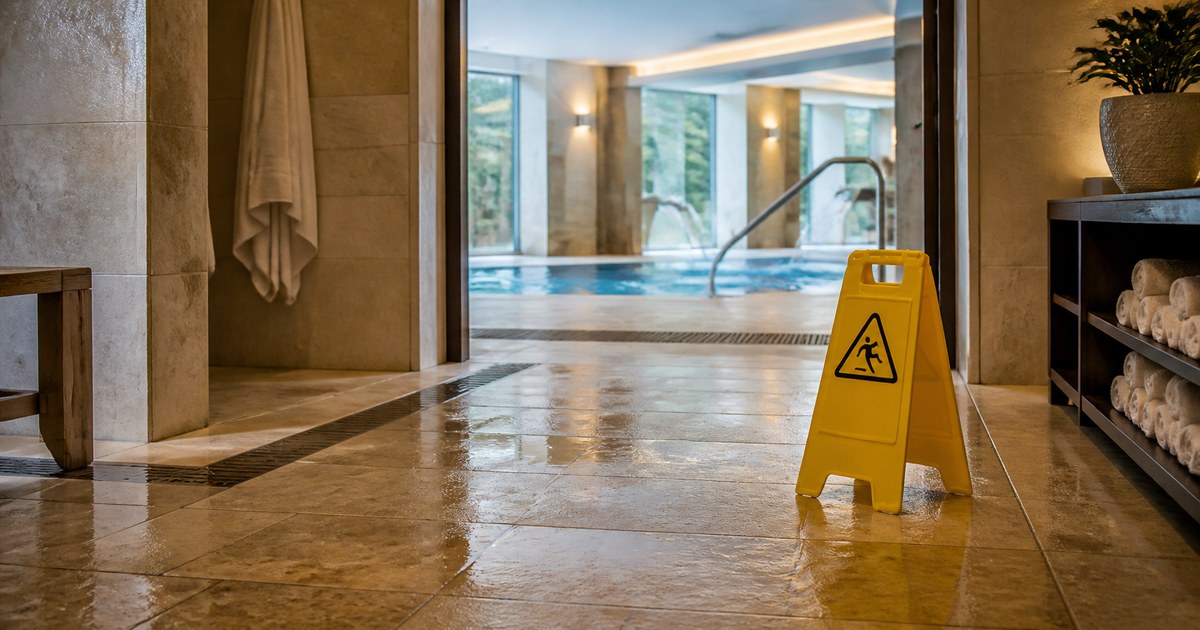
Water is foreseeable near a swimming pool. That does not dispose of the claim in the hotel's favour. Foreseeability may make a safety system suited to normal guest use more important.
A technical assessment may examine
- material and finish;
- wear and surface treatment;
- performance when wet;
- shod and barefoot use;
- slope and drainage;
- water accumulation;
- inspection and cleaning routines;
- warning position and visibility.
An anti-slip product sheet does not by itself prove that the area was safe when the guest fell. Similarly, a photograph of a warning sign proves that it existed when the photograph was taken; it does not automatically show that it was there before the accident.
Earlier guest reviews may help investigate prior knowledge, but rarely prove liability by themselves. Preserve the original URL and date and establish that the comment concerns the same surface, without intervening works or material changes.
What does Portuguese law require from a hotel?
The accommodation contract
Articles 798, 799 and 800 of the Portuguese Civil Code address culpable non-performance, the presumption of fault and acts of assistants. In a 2006 decision, the Coimbra Court of Appeal held that hotel accommodation includes a duty to provide safe conditions for guests and their property.
Tort and omissions
Articles 483 and 486 of the Portuguese Civil Code cover culpable infringement of rights and omissions where there was a legal or contractual duty to act. Cleaning, maintenance, repair, supervision and warnings may be relevant, depending on the proven facts.
Consumer and tourism protections
Portugal's Consumer Protection Act protects physical safety and provides compensation for defective services. Article 22 of the Tourism Framework Act refers to personal safety, maintenance, hygiene, cleanliness and accident-prevention information.
Pools and common facilities
Ministerial Order 358/2009, which remains in force, requires common tourist facilities to be kept in adequate conditions of hygiene, cleanliness, conservation and operation and expressly addresses hotel pools, decks, access and adjoining areas. It does not justify alleging a breach of a particular slip-resistance class without technical evidence.
What have Portuguese courts considered?
In 2020, the Guimarães Court of Appeal considered a wet polished-marble corridor, the absence of cleaning staff at that moment and a warning located only in another area. In 2025, the Coimbra Court of Appeal found liability after a guest slipped on an unsigned wet floor inside a hotel. These decisions are useful examples, not automatic compensation tables.
What loss may be included in compensation?
Articles 562 to 566 of the Civil Code seek to restore the position that would have existed without the accident. A bodily-injury assessment may include:
- emergency care, surgery, medication, physiotherapy and necessary treatment;
- foreseeable future treatment and help from another person;
- actual salary, bonus or earning-capacity loss;
- travel and additional expenses caused by the injury;
- temporary or permanent functional impairment, even if salary continues;
- pain, loss of independence, scarring and effects on family or leisure;
- non-refundable trip costs after credits, refunds and insurance are deducted.
There is no fixed amount for a fall, fracture or medical-legal point. The assessment is individual and depends on evidence. English-speaking visitors may also find our Portuguese legal glossary useful when reviewing documents.
What if the injured guest lives outside Portugal?
For the tort limb of the claim, Article 4 of the Rome II Regulation generally points to the law of the country where the direct damage occurs. An injury sustained in a Portuguese hotel is therefore usually assessed under Portuguese law even if surgery, wage loss or other indirect consequences arise later in another country. Contract law and court jurisdiction require separate review of the booking, parties and terms.
Foreign medical costs and income are not automatically replaced by Portuguese averages. They should be documented, tested for causation and coordinated with health insurance, travel insurance, an employer and any subrogation claim.
A visitor who cannot travel back may be represented through a Portuguese power of attorney. Remote representation does not remove the need to keep original evidence.
Was the hotel part of a package holiday?
Under Decree-Law 17/2018, travel agencies are responsible to clients for contracted travel services and, for package travel, even where a third party performs them. Keep the contract and report the lack of conformity. This does not make the organiser automatically liable for every accident.
Can the guest's conduct reduce compensation?
Yes. Article 570 of the Civil Code allows compensation to be reduced or excluded where the injured person's culpable conduct contributed to the damage. A hotel may raise running, entering a closed area, footwear, alcohol, inattention or disregard of a visible warning.
Those allegations need evidence and a causal link. Walking normally, using a pool as intended or being barefoot in an area designed for that use does not by itself amount to accepting any hazard.
Time limit: three years does not mean it is safe to wait
For tort liability, Article 498 generally provides three years from knowledge of the right, with exceptions including conduct that amounts to a crime subject to a longer period. A contractual claim has a different limitation analysis.
Do not assume that a complaint to the hotel, insurer involvement or settlement correspondence stops time running. The legal basis and effective interruption acts must be checked. In practice, CCTV, witnesses, cleaning records and the floor itself may disappear much earlier.
The appropriate defendant and any direct claim against an insurer depend on the operator, policy and communications. A Portuguese lawyer can identify the legal entity, preserve evidence and separate the hotel's, insurer's and package organiser's potential roles. You can read more about the lawyer responsible for this guide and the firm's Portugal offices.
Request an assessment of a hotel fall
Briefly state the date, precise location, floor condition, warnings, injury and evidence already preserved. Do not include unnecessary medical details or documents in this field.
Frequently asked questions
Does every fall in a Portuguese hotel lead to compensation?
No. The fall must be linked to an unsafe condition or a breach of a safety, maintenance, cleaning, supervision or warning duty, and the resulting loss must be proved. The fact that a guest fell does not create automatic liability.
Can a hotel argue that water is normal near a swimming pool?
Foreseeable water does not remove the safety duty. It may make flooring, drainage, cleaning and effective warnings more important. Liability depends on the actual location, normal use and evidence.
What photographs should I take after a hotel slip?
Photograph the precise spot, the route to it, water or defects, flooring with scale, drainage, lighting and every warning sign. Keep the original files and record each sign's position in relation to the fall.
Does a wet-floor sign protect the hotel from liability?
Not automatically. It matters whether the sign was present before the fall, visible, close enough and adequate for the hazard. A sign in another area or added later has a different evidential value.
Is an anti-slip flooring certificate conclusive?
Not necessarily. Material, wear, water, slope, drainage, cleaning, surface treatment, barefoot use and warnings may all matter. A technical classification is one part of the real-world assessment.
What compensation may be claimed?
Depending on the evidence, a claim may include medical and future treatment costs, lost income, assistance, travel, functional impairment, pain, scarring and daily-life effects. Insurance payments and subrogation rights must be identified to prevent double recovery.
Can I claim medical costs incurred outside Portugal?
They may be relevant if necessary, reasonable and caused by the accident. Separate the amount billed, insurer adjustments, amounts paid by the insurer or patient, outstanding balances and any reimbursement or subrogation claim.
What if the hotel was booked as part of a package holiday?
The organiser's and retailer's responsibilities may need to be considered in addition to those of the hotel and insurer. Keep the package contract, booking and terms, and notify the package contact of the lack of conformity.
What is the time limit for a hotel injury claim in Portugal?
For a tort claim, Article 498 of the Portuguese Civil Code generally provides three years from knowledge of the right, subject to exceptions. Contract, crime and valid interruption acts may change the analysis. Do not assume that negotiations or emails stop time running.
Portuguese legal and case-law sources
- Portuguese Civil Code: Articles 483, 486, 496, 498, 562–570 and 798–800.
- Act 24/96: physical safety and compensation for defective services.
- Decree-Law 191/2009: Article 22, tourist rights.
- Ministerial Order 358/2009: common facilities and swimming pools.
- Coimbra Court of Appeal, 21 March 2006, case 299/06: the accommodation contract's ancillary safety duty.
- Guimarães Court of Appeal, 9 June 2020, case 611/18.8T8VCT.G1: fall in a hotel SPA/pool access corridor.
- Coimbra Court of Appeal, 24 June 2025, case 4535/22.6T8LRA-C1: an unsigned wet hotel floor.
- Portuguese Civil Procedure Code: Articles 419 and 420, early taking of evidence.
Reviewed on 22 August 2026. This article is for information only and is no substitute for a lawyer's assessment of the specific case.